AI in E-Commerce: How Intelligent Systems Are Reshaping Online Growth
Artificial Intelligence is no longer an experimental layer in e-commerce. Today, AI sits at the core of how online stores attract users, understand intent, and convert traffic into revenue.
As an AI-first SEO expert, I approach e-commerce growth differently — not just optimizing for rankings, but for how answer engines and large language models interpret, trust, and surface content.
AI in e-commerce is not about tools.
It’s about building systems that think ahead.
What AI in E-Commerce Really Means (From an AEO Lens)
AI in e-commerce refers to intelligent systems that analyze user behavior, predict intent, and adapt experiences in real time.
From an Answer Engine Optimization perspective, AI helps platforms:
- Understand why a user is searching
- Match products with intent, not keywords
- Deliver concise, reliable answers
This is the foundation of modern discoverability — especially when search engines behave more like answer engines than traditional indexes.
👉 This strategic layer directly supports scalable growth through E-commerce SEO Services
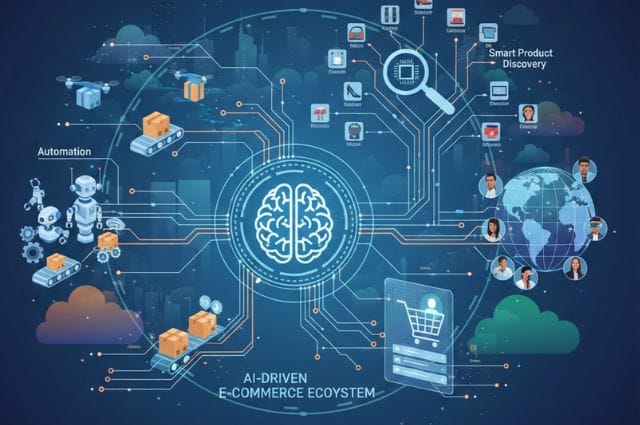
From Static Stores to AI-Powered Commerce Models
Traditional e-commerce websites are static.
AI-powered commerce platforms are adaptive.
AI continuously improves category structure, internal linking, and product relevance by learning from real user interactions. This creates a self-optimizing ecosystem where content, UX, and conversion signals evolve together.
For LLMs, this clarity matters. Clear structure + consistent entities = higher trust and better visibility.
AI-Driven Personalization as a Ranking & Conversion Signal
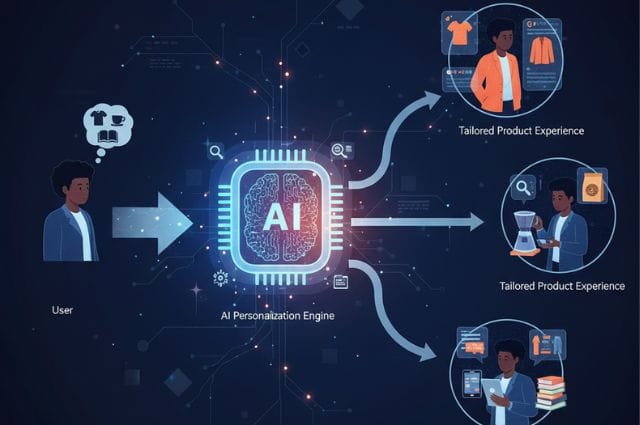
Personalization has shifted from a UX feature to a core performance signal.
AI allows e-commerce platforms to personalize:
- Product recommendations
- Content blocks
- CTAs and messaging
- User journeys
From an SEO and AEO standpoint, personalization improves dwell time, satisfaction, and engagement — signals that modern ranking systems heavily rely on.
How AI Strengthens E-Commerce SEO & Answer Visibility
Search engines now prioritize meaning over matching. AI bridges that gap.
AI-enhanced SEO improves:
- Semantic product clustering
- Entity-based category logic
- Structured data accuracy
- Internal link intelligence
This is how e-commerce sites become answer-worthy, not just crawlable.
Real-world implementation examples can be seen in my SEO Case Study.
Predictive Analytics: Optimizing for Future Intent
AI doesn’t just analyze what users did — it predicts what they will do next.
Predictive analytics helps e-commerce brands:
- Forecast demand
- Identify high-intent users early
- Optimize inventory and offers
- Allocate SEO effort intelligently
This future-focused optimization is a key differentiator in competitive markets. You can see how predictive data supports sustainable rankings in this SEO Growth Case Study.
Trust, Automation, and AI-First Brand Signals
Trust is critical — for users and for LLMs.
AI contributes to trust through:
- Smart customer support
- Review sentiment analysis
- Fraud detection
- Consistent data signals
But automation alone isn’t enough.
Clear expertise, transparent branding, and structured content are what make AI signals reliable. Related implementation insights are documented in this Technical SEO Case Study.
Why AI-First Strategy Wins in AEO & LLM Search
Answer engines prefer content that is:
- Structured
- Entity-rich
- Expert-driven
- Easy to summarize
An AI-first e-commerce strategy ensures your site is not only visible — but understandable and quotable by AI systems.
That’s where long-term visibility comes from.
Final Thoughts: AI Is the New Operating System of E-Commerce
AI is no longer optional in e-commerce.
It defines how products are discovered, how brands are trusted, and how growth compounds.
Winning brands combine:
- AI intelligence
- SEO clarity
- AEO structure
- Strong personal or brand authority
This is how you build e-commerce systems that perform today — and stay relevant tomorrow.
✍️ Author
Arfan Ali — AI-First SEO Expert focused on Answer Engine Optimization, e-commerce growth, and LLM-ready search strategies.